
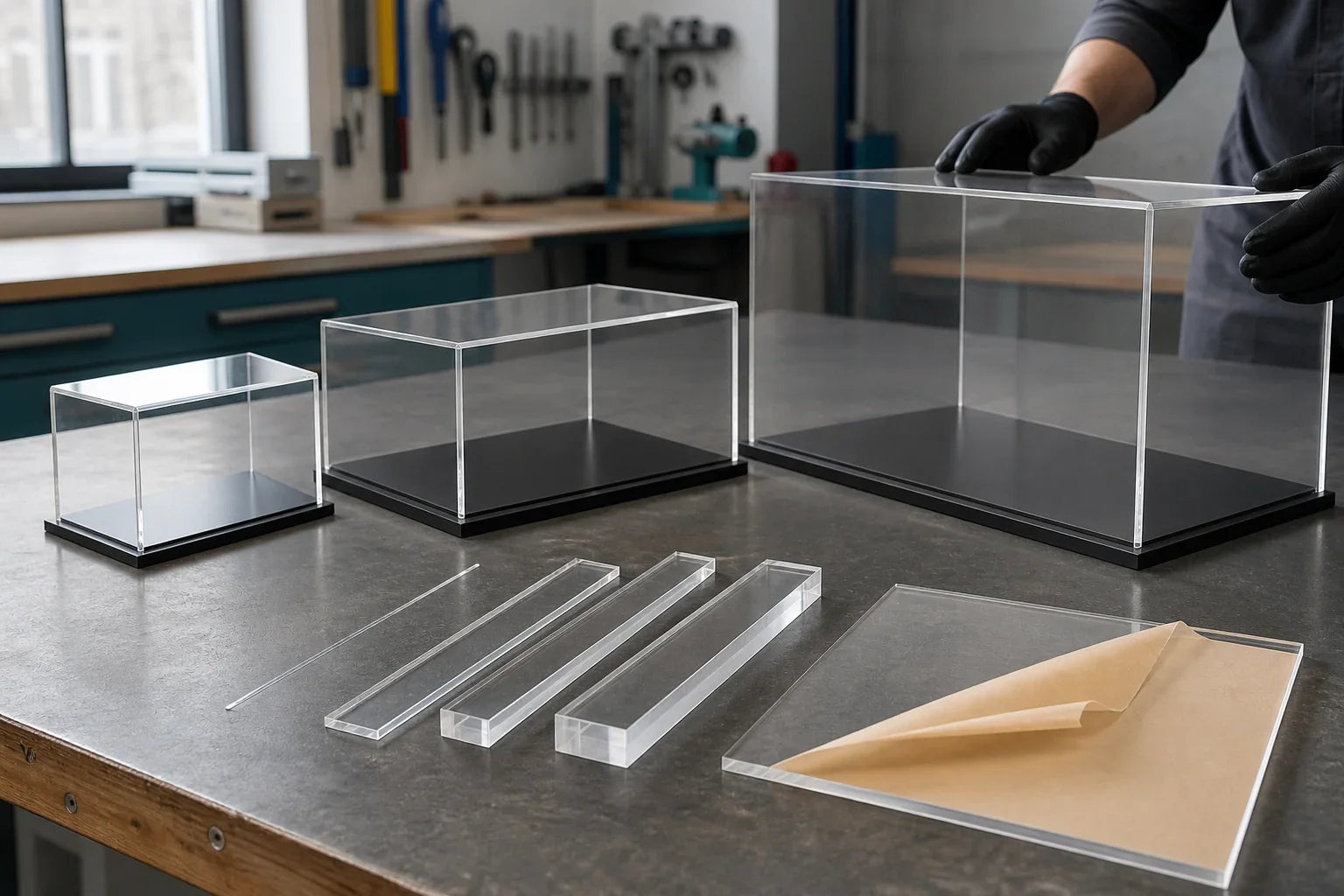
The right acrylic thickness is what makes a display case feel crisp and stable rather than flexible or overbuilt. It also affects the finished weight, price, polished-edge appearance and the amount of usable space inside the cover.
For a custom display case, thickness should be chosen from the largest external dimension—height, width or depth—not from the object type alone. A tall narrow case and a low wide case can therefore require different materials even when they enclose similarly sized objects.
Puffin Plastics display case thickness guide
The Puffin custom display case calculator uses the following minimum material rules:
| Largest external dimension | Minimum acrylic thickness | Typical use |
|---|---|---|
| 50–300mm | 3mm | Compact models, small memorabilia and tabletop objects |
| 301–500mm | 4mm | Medium models, single boots, balls and many domestic displays |
| 501–800mm | 5mm | Larger models, grouped objects and substantial memorabilia |
| 801–900mm | 6mm | Large covers needing greater rigidity |
| Within the calculator's permitted sizes | 8mm or 10mm optional | Extra rigidity or a heavier premium edge appearance |
| Any dimension over 900mm | Quotation required | Individual structural, fabrication, handling and delivery review |
These thresholds are not decorative suggestions. They prevent customers selecting a sheet that is too thin for the case span. Inadequate thickness can contribute to visible bowing, stressed joints, flare cracks and damage in handling or transit.
Why a small thickness increase makes a big difference
Acrylic sheet becomes much more resistant to bending as it gets thicker. The change is not merely proportional: in a simple flat sheet under similar conditions, bending rigidity rises roughly with the cube of thickness. The completed case shape, bonded corners, proportions and support all matter too, but this principle explains why moving from 3mm to 4mm can feel more significant than the one-millimetre difference suggests.
Thickness also changes:
- Edge presence: thicker polished edges create a more substantial visual frame.
- Weight: more material makes the lift-off cover heavier.
- Internal space: thicker side walls reduce the internal width and depth for the same external size.
- Price: thicker sheet costs more and may require more fabrication time.
- Handling: a rigid cover is reassuring, but a very heavy cover can be awkward to remove frequently.
When 3mm acrylic is appropriate
Three-millimetre acrylic is well suited to compact covers whose largest external dimension is no more than 300mm. It keeps a small display visually light, avoids a needlessly chunky edge and is easy to lift for occasional cleaning.
Typical candidates include small die-cast models, jewellery, miniature figures, compact trophies and individual small collectables. The same material would not be appropriate simply because the object is lightweight if the case itself has a long unsupported panel.
When to choose 4mm acrylic
Four-millimetre acrylic is the minimum once the largest external dimension reaches 301–500mm. This range covers many popular household displays, including footballs, adult boots, medium models, clocks and compact sculptures.
It offers a useful balance between rigidity, weight and cost. Customers sometimes choose 4mm for a case that could technically use 3mm because they prefer the stronger polished edge and more solid feel. That is a visual choice; going thinner than the required minimum is not.
When 5mm acrylic is needed
Five-millimetre sheet is the minimum for cases whose largest external dimension is 501–800mm. At this scale, longer panels create more leverage and have more opportunity to flex. The extra material helps the cover hold its geometry and makes larger bonded edges more substantial.
Five millimetres is common territory for larger architectural models, grouped sports displays, wide model vehicles, substantial sculptures and multi-item collections. It is also worth considering when a case will be moved periodically, although every cover should still be supported and lifted carefully with two hands.
When 6mm, 8mm or 10mm makes sense
Six-millimetre acrylic is the minimum from 801–900mm. Eight- and ten-millimetre options can provide additional rigidity and a deliberately bold, gallery-style edge where the calculator permits them.
Thicker is not automatically better. Consider:
- Will one person need to lift the cover regularly?
- Can the furniture support the finished case and object?
- Does the thicker edge suit the scale of the display?
- Will the reduced internal space still provide the required clearance?
- Can the case be delivered safely through doors, stairs and tight corners?
If any external dimension exceeds 900mm, send a drawing and photographs through the contact page. Very large cases need more than a thickness choice: panel proportions, access, joint design, transport and final location all require review.
Use the largest dimension, not an average
Imagine a case measuring 650mm wide, 250mm deep and 220mm high. Its average dimension is below 500mm, but the 650mm width places it in the 5mm minimum range. Averaging the dimensions would hide the longest unsupported span—the part most likely to flex.
The same rule applies if height is largest. A tall case measuring 350 × 350 × 700mm belongs in the 5mm range because of its 700mm height.
Thickness changes the internal measurements
Puffin's calculator asks for external dimensions. A conventional five-sided cover loses twice the sheet thickness from its internal width and depth, because it has a wall on both sides. Usable height loses the top-panel thickness, plus 6mm where the cover locates into a Puffin base.
For example, changing a 500mm external-width case from 4mm to 5mm acrylic reduces the theoretical internal width from approximately 492mm to 490mm. That sounds small, but it matters when an item has only a few millimetres of clearance. Read how to measure for an acrylic display case before entering a close-fitting size.
What thickness does not tell you
Thickness is only one part of case quality. Also consider:
- Material grade: cast and extruded acrylic can have different fabrication characteristics.
- Joint finish: accurately prepared, well-bonded edges matter as much as the nominal sheet size.
- Polishing: clean polished edges improve clarity and presentation.
- Base design: the cover should locate securely without being forced.
- Proportions: a very long, shallow panel behaves differently from a compact cube.
- Environment: heat, direct sun, frequent public handling and repeated access can change the specification.
A display cover is not a load-bearing shelf. Do not place books, equipment, other cases or heavy decorations on top, regardless of material thickness.
Choosing thicker acrylic for appearance
A thicker polished edge catches more light and can give a valuable object a stronger architectural frame. That can work beautifully for jewellery, awards, premium retail displays and gallery objects. For a tiny miniature, however, a 10mm edge may dominate the subject.
Make the choice in proportion to the object and its surroundings. If possible, compare physical acrylic samples rather than judging thickness from a screen.
Frequently asked questions
Is 3mm acrylic thick enough for a display case?
Yes, for a properly proportioned small case whose largest external dimension is 300mm or less. It is not suitable merely because the object is light; the finished panel span determines the minimum.
Is 5mm acrylic better than 4mm?
It is more rigid and has a heavier edge, but it also weighs and costs more. Use at least the minimum required for the case size, then choose extra thickness only when its rigidity, handling and appearance suit the project.
Does thicker acrylic provide more UV protection?
Do not use thickness as a UV-protection specification. Standard clear acrylic can be resistant to weathering without being a verified UV filter for the item inside. Light-sensitive exhibits may require specialist UV-absorbing material and controlled lighting.
Can I choose a thinner material to save money?
No. The calculator's minimum moves with the largest dimension to protect the case from unsuitable combinations. Reduce the overall case size if practical, or ask for advice about a different construction.
What if my design falls exactly on a threshold?
Use the range containing the finished external dimension and allow for any rounding. If changing a base, mirror or clearance pushes the case above 300mm, 500mm or 800mm, the next minimum thickness applies.
Ready to specify your case? Measure the complete display, choose the required clearance, then use the custom acrylic display case calculator. For dimensions over 900mm or an unusual shape, request a quotation instead.