
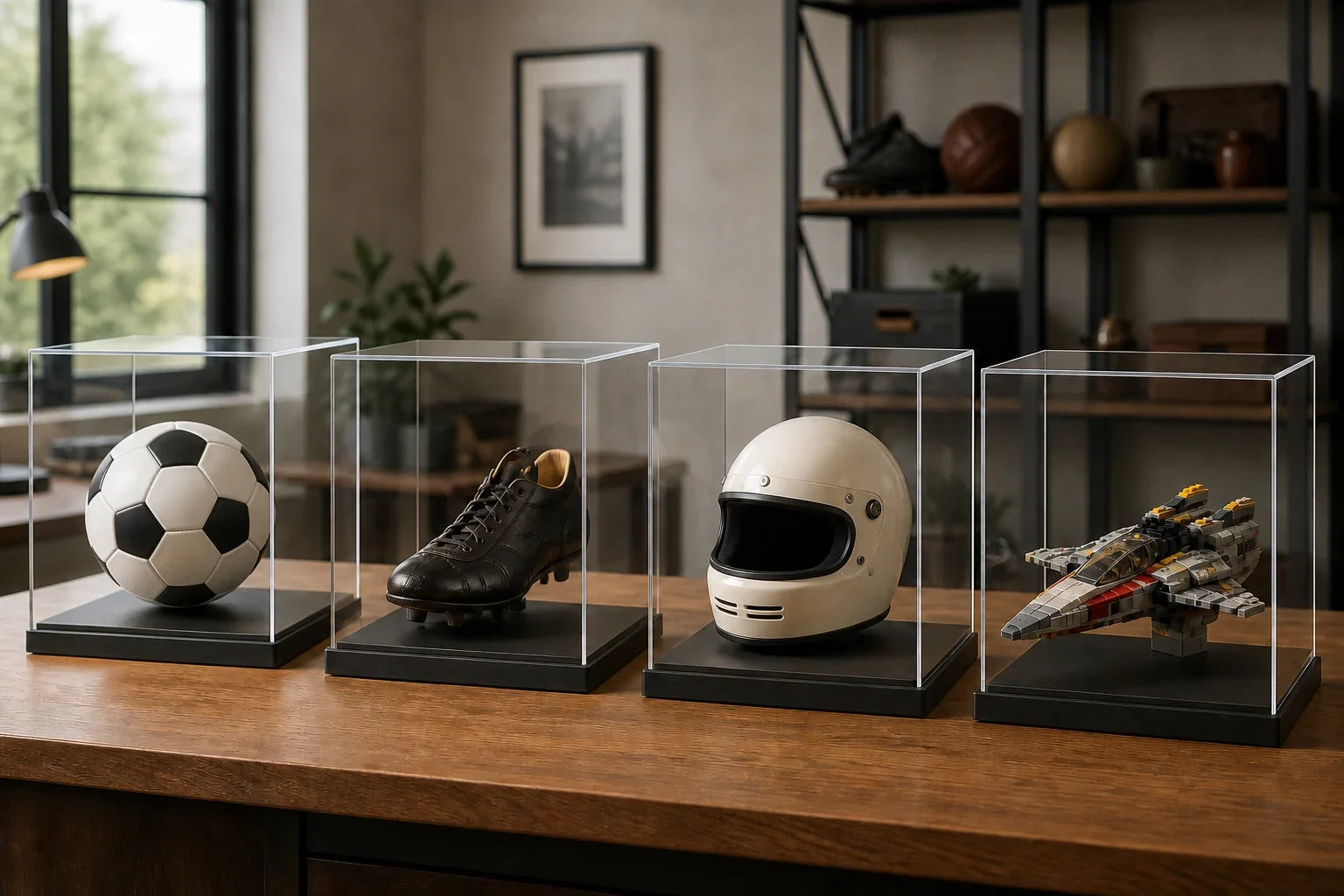
Good display-case clearance is part protection and part presentation. Too little space makes an object look squeezed in and increases the chance of laces, aerials, visors or model details touching the acrylic. Too much space can make the display feel lost and may push the case into a more expensive material or delivery band.
For many stable objects, 20–30mm of clear internal space on each side and above is a sensible starting point. Delicate, irregular or visually complex pieces often benefit from 30–50mm. The correct allowance always depends on the object's final pose, its mount and how the clear cover will be fitted or removed.
What “clearance” means
Clearance is measured from the object's furthest point to the inside face of the acrylic—not to the external edge of the finished case. Treat the object, stand, riser, plaque and every accessory as one occupied three-dimensional envelope.
If you want 25mm on both the left and right, add 50mm to the object's occupied width. If you want 25mm at the front and rear, add 50mm to the occupied depth. Height usually needs clearance only above the highest point because the display stands on the base.
Practical starting clearances
| Display type | Starting internal clearance | Details commonly missed |
|---|---|---|
| Football on a ring or stand | 20–30mm each side and above | Inflation, stand height, inscription plaque and rotated panel orientation |
| Single football boot | 25–40mm around the posed boot | Toe angle, studs, loose laces, heel support and plaque |
| Helmet | 30–50mm around the widest profile | Visor position, peak, spoiler, chin bar, cables and display stand |
| Brick-built model | 30–50mm around fragile projections | Wings, aerials, figures, stand angle, future modules and safe lowering of the cover |
| Compact solid object | 15–25mm may be enough | Visual centring, irregular silhouette and safe finger space |
These figures are useful design starting points, not guaranteed case sizes. Always measure the real object. A nominal size-5 football is roughly 22cm in diameter, for example, but inflation, age, panel construction and the chosen stand can change the occupied dimensions.
Football display case clearance
Place the football on the exact ring, grass-effect base, riser or holder you intend to use. Rotate it so the signature, crest or important panel faces forward. Then measure the complete occupied width, depth and height.
For a single modern football, 20–30mm of internal space on each side and above normally gives a clean, intentional border. Increase it when:
- The ball sits at an angle rather than upright
- A plaque or mount projects in front
- You want space for a photograph, medal or programme
- The display will be viewed from several directions
- The ball is especially valuable and should never approach a case wall during removal
If you want a ready-made sports design, browse the football display case collection. For an unusual mount or multi-item arrangement, size a bespoke acrylic case around the complete display.
Football boot display case clearance
Boots are harder to size than balls because their shape and display angle vary. Measure the boot after arranging the laces and deciding whether it will sit flat, rise at the heel or turn three-quarters towards the viewer.
Use 25–40mm as a practical starting clearance around the posed boot. Check five areas:
- Toe: often the furthest forward point.
- Heel: may project backwards when the boot is angled.
- Studs: change height and can make the boot unstable without a support.
- Laces: loose loops can touch a wall even when the leather upper clears it.
- Plaque or signature view: leave enough front space to read it without the object looking pressed against the cover.
Two boots are not simply twice the size of one. Arrange the pair first—parallel, crossed, heel-to-toe or on staggered mounts—then measure the whole composition. The boot display case collection includes single and double options that can provide a useful reference.
Helmet display case clearance
Helmets have broad curved profiles and projections that are easy to miss. Place the helmet on its stand and set the visor exactly as it will be displayed. Measure:
- The widest side-to-side point
- The furthest point from visor or peak to the rear shell or spoiler
- The total height from the display surface to the top of the shell, fin or aerial
Around 30–50mm of clearance normally gives a helmet room to breathe and allows the cover to be lowered without clipping a visor or peak. Use more where cables, hydration fittings, radio equipment or a complex stand project outside the shell.
For motorsport pieces, do not rely on the size printed inside the helmet; that describes the wearer's fit, not the external display envelope. See the cap and helmet display collection or measure for a custom case.
Brick-built and model display case clearance
Brick-built models, model ships, aircraft and architectural miniatures often have tiny parts that extend beyond the main body. These are exactly the pieces most likely to catch the case if clearance is too tight.
Start with 30–50mm around the furthest projections. Consider extra space for:
- Wings, sails, masts, antennae and propellers
- A model displayed diagonally on its stand
- Figures or vehicles arranged around the main build
- A cable for approved low-heat lighting
- Future expansion modules you genuinely plan to add
- Two-handed removal of the acrylic cover without touching the model
Measure a model on the base you intend to use. Do not trust the retail box dimensions, and do not assume the model's published dimensions include its stand or movable parts. For made-to-measure builds, use the custom brick-built model display case.
Visual clearance versus physical clearance
A case can be physically large enough but still look wrong. Before ordering, build a quick mock-up:
- Mark the proposed internal footprint on a table using low-tack tape.
- Place the object in the centre.
- Stand cardboard sheets at the proposed wall positions.
- View it from the normal seated or standing position.
- Move the boundaries until the object feels neither cramped nor lost.
This is particularly valuable for asymmetric objects. A helmet may need more visual space in front of the visor than behind the shell even when the case remains externally rectangular.
Remember the base, top and mirror backing
Clearance calculations describe the usable space. You still need to convert that space into external dimensions:
- Add twice the acrylic thickness to required internal width and depth.
- Add the top-panel thickness to required internal height.
- Add another 6mm to height when using a Puffin base.
- Add 3mm to depth if mirror backing is selected and you want to preserve the same rear clearance.
- Allow for Puffin's stated ±1mm workshop tolerance rather than designing a zero-clearance fit.
The full calculation is shown in How to Measure for a Custom Acrylic Display Case.
When more clearance is safer
Choose the upper end of the range—or exceed it—when the object is fragile, valuable, soft, unstable, irregular or likely to be moved. More space is also sensible when the cover is large and must be lowered over the display by two people.
Do not rely on the acrylic wall to hold an object upright. Use a proper stand, mount or discreet support so the item remains stable even when the case is lifted away.
Frequently asked questions
Can the object touch the acrylic?
It should not. Contact can create scratches, pressure points, dye transfer or abrasion, and it makes cover removal risky. Give every projection positive clearance.
Should every side have identical clearance?
Not necessarily. A front-facing display may need extra room for a plaque or visor. Calculate the occupied rectangular envelope first, then position the object within the internal space for the best view.
How much room should I leave above a model?
Twenty to thirty millimetres is a useful start for a sturdy compact object; 30–50mm is safer for aerials, masts, figures and fragile projections. Increase it when the cover will be removed frequently.
Can I leave room for future additions?
Yes, if the additions are planned and measured. Avoid ordering a dramatically oversized case for vague possibilities, because the extra span may require thicker material, cost more and look visually empty.
Next step: arrange the complete display, record its occupied dimensions, choose the clearance, then calculate the finished external size in the Puffin bespoke case calculator.