
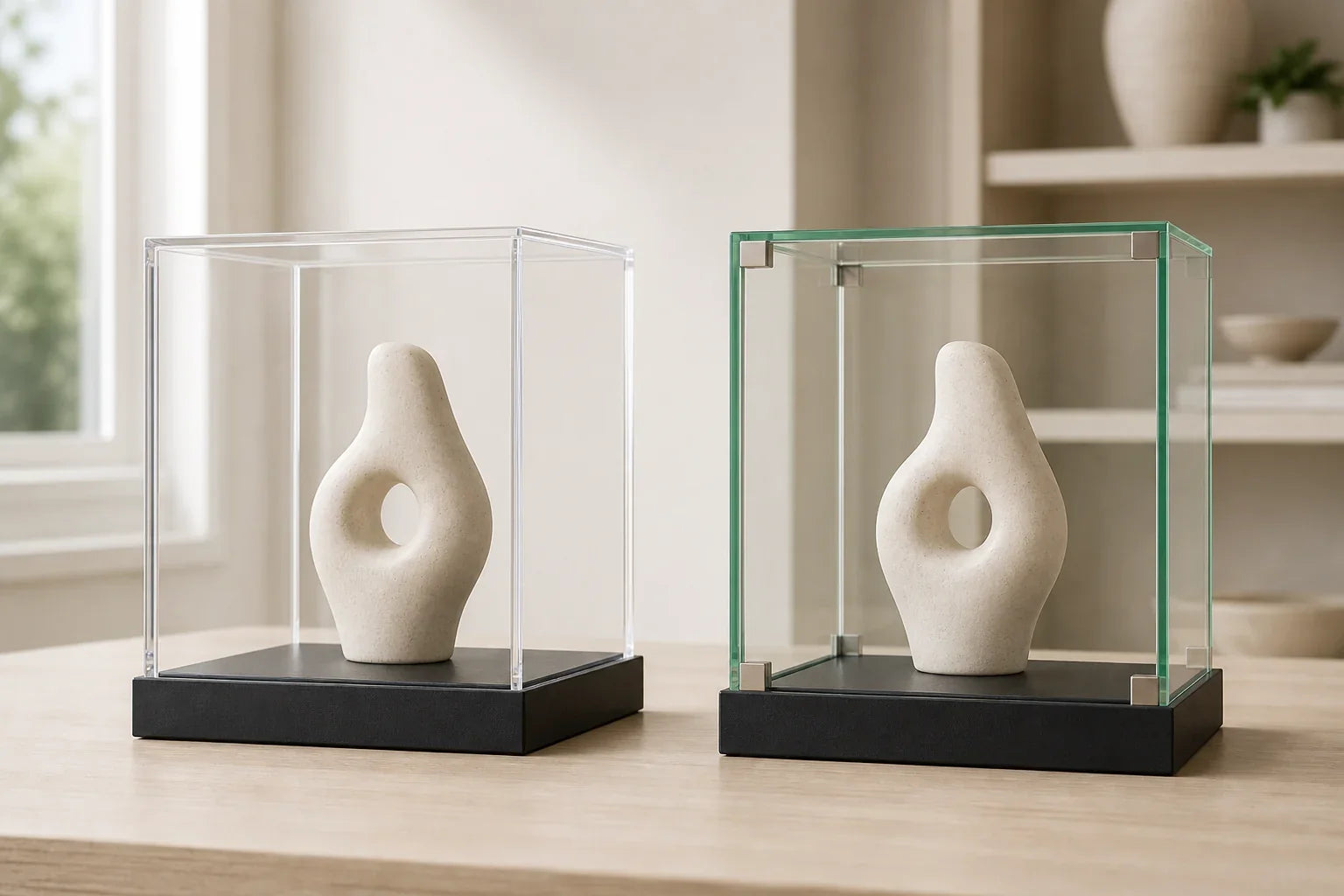
Acrylic and glass are both clear materials, but they create very different display cases. Acrylic is lighter, highly transparent and easier to fabricate into a seamless lift-off cover. Glass is harder, more resistant to everyday scratching and can be preferable for rigid permanent glazing. Neither is automatically best for every object.
This comparison covers the differences that matter in a home, gallery, museum, sports club or retail environment—and corrects a common misconception about UV protection.
Acrylic vs glass at a glance
| Consideration | Acrylic | Glass |
|---|---|---|
| Weight | Approximately half the weight of glass at the same thickness | Heavier; large covers may be difficult to lift |
| Clarity | Quality clear acrylic can transmit more than 92% of visible light with little colour bias | Very clear, but ordinary thick glass can show a green edge tint |
| Impact | More impact-resistant and less prone to shattering than ordinary glass | Hard but brittle unless a specialist toughened or laminated grade is used |
| Scratching | Softer surface; needs acrylic-safe cleaning, but light marks may be polishable | Harder and more resistant to routine surface scratches |
| Rigidity | Can flex, so case size determines the required sheet thickness | Stiffer at comparable thickness but substantially heavier |
| Fabrication | Can be cut, machined, bonded, polished and formed into clean custom shapes | Custom machining and joining usually require specialist glazing methods and hardware |
| UV protection for contents | Special UV-filtering grades exist; standard clear acrylic should not be assumed to provide conservation protection | Special UV-filtering glass exists; ordinary glass is not complete UV protection |
| Cleaning | Requires a damp soft cloth and acrylic-compatible product | Tolerates a wider range of conventional glass-cleaning methods |
Clarity and colour
High-quality clear cast acrylic is exceptionally transparent. PERSPEX®—a well-known brand of acrylic, or PMMA—states visible-light transmission above 92% for its clear cast sheet. It also has very little colour bias, which helps white bases, fine details and true object colours remain clean when viewed through the panel.
Ordinary float glass is also very clear, especially in thin sheets. As glass becomes thicker, iron content can create a visible green edge and a subtle colour cast. Low-iron glass reduces this effect but is a different, usually more expensive specification.
In practice, reflections, dust, lighting and edge workmanship can matter as much as the headline transmission figure. A clean, well-lit case made from either material will outperform a poorly positioned one.
Weight and everyday handling
Acrylic is roughly half the weight of glass at the same thickness. That makes a substantial difference when a five-sided cover must be lifted off for cleaning or rearranging the object.
Lower weight can mean:
- Easier two-handed removal
- Less load on a shelf or cabinet
- Safer transport through a home or exhibition
- Larger practical cover sizes before handling becomes difficult
Lightweight does not mean flimsy. The acrylic thickness must still match the largest case dimension. Review the acrylic display-case thickness guide before comparing covers of different sizes.
Impact resistance and breakage
Acrylic is significantly more impact-resistant than ordinary glass and is less likely to shatter into sharp fragments. This is helpful in family homes, busy club environments, retail displays and any location where a lift-off cover is handled periodically.
It is not unbreakable. Acrylic can crack if dropped, forced onto a base, drilled incorrectly or exposed to incompatible chemicals that create stress crazing. A large cover should always be supported with two hands and never carried by one edge.
Glass performance depends heavily on its specification. Toughened and laminated safety glass behave differently from ordinary annealed sheet, so a serious public-space comparison must name the exact grade rather than treating all glass as identical.
Scratches and long-term appearance
Glass wins for surface hardness. It generally tolerates dusting and routine cleaning better, although abrasive grit can still mark it.
Acrylic needs more deliberate care. Dry cloths, paper towels, scouring pads and unsuitable household cleaners can leave fine scratches or haze. The advantage is that small marks in acrylic can sometimes be polished out with a product made specifically for the material. Scratched glass is much harder to restore invisibly.
Follow the full acrylic display-case cleaning guide to protect the polished surface.
Rigidity and large cases
Glass is stiffer than acrylic. It resists bowing well, which is one reason it remains common in large framed cabinets and permanent architectural glazing. Its weight, brittleness and joining requirements also increase with scale.
Acrylic's flexibility must be managed through thickness, proportions and bonded construction. A correctly specified five-sided cover gains considerable stiffness from its corners, but a long panel made from sheet that is too thin can still bow. That is why Puffin's minimum thickness rises with the largest external dimension.
For dimensions over 900mm, do not extrapolate the online calculator. Ask for an individual quotation covering material, access, fabrication and delivery.
Custom shapes, joints and polished edges
Acrylic is exceptionally versatile in a fabrication workshop. It can be:
- Cut accurately to size
- CNC-routed or laser-cut where appropriate
- Bonded into a clean five-sided cover
- Flame-polished or mechanically polished
- Bent or formed for specialist projects
- Combined with coloured, mirrored or solid bases
This makes acrylic particularly effective for made-to-measure objects and small production runs. Glass fabrication is possible, but holes, notches, edge treatment, safety processing and joints usually require a specialist glazier and may rely on visible hardware or silicone.
The truth about UV protection
This distinction matters: resistance to UV weathering is not the same as filtering UV to protect an exhibit.
Standard quality acrylic can remain clear and stable during outdoor exposure, but that does not prove that it blocks the wavelengths responsible for fading sensitive paper, textiles, signatures or dyes. Specialist UV-absorbing acrylic grades are available, just as specialist conservation glass is available. Their performance must be specified and verified.
For valuable light-sensitive objects, combine suitable glazing with controlled lighting, low-UV sources and avoidance of direct sunlight. A clear cover alone is not a complete conservation plan.
Dust, access and environmental control
A well-fitting acrylic or glass enclosure reduces dust, handling and accidental contact. Neither automatically creates an airtight museum microclimate.
Glass is less permeable to water vapour, which can make it preferable in specialist sealed enclosures. However, seals, adhesives, base materials, ventilation and pollutant control determine the performance of the complete case. Museums displaying sensitive or irreplaceable objects should work with a conservator and state the required environmental specification before manufacture.
Which material suits which situation?
Choose acrylic when:
- You want a lightweight lift-off cover
- The case needs exact custom dimensions
- Impact resistance matters more than maximum scratch resistance
- Clean bonded corners and polished edges suit the display
- The case may need to travel to events or exhibitions
- A coloured, mirrored or fabricated base is part of the design
Consider glass when:
- The enclosure will remain in place and rarely be lifted
- Maximum resistance to routine surface scratching is important
- The cabinet is framed and designed for glass from the outset
- A specialist sealed museum system or precise conservation glazing specification is required
- The supporting furniture and installation can safely accommodate the weight
Consider another material when:
Where severe impact or vandal resistance is the primary requirement, polycarbonate may be more appropriate than either ordinary acrylic or ordinary glass. Its optical appearance and scratch behaviour differ, so it should be selected as part of a complete risk assessment rather than treated as a transparent substitute.
Cost is more than the sheet price
Compare the whole project: material, cutting, edge finishing, joints, hardware, base, delivery, installation and future handling. Acrylic often performs strongly for one-off custom covers because it is easy to machine and bond and is lighter to ship. A permanent standard-size cabinet may favour glass. The cheapest sheet is not necessarily the lowest-cost finished display.
Frequently asked questions
Is acrylic clearer than glass?
Quality clear acrylic can have very high light transmission and less edge colour than ordinary glass. Low-iron specialist glass can also be exceptionally clear. Material grade, thickness, lighting and cleanliness all affect the result.
Does acrylic turn yellow?
Quality cast acrylic is designed for long-term clarity and weather resistance, but performance depends on the grade, environment and chemical exposure. Avoid unsupported claims about unknown sheet material and use an established supplier.
Are acrylic cases scratch-proof?
No. Acrylic is softer than glass and can scratch, especially when cleaned dry or with abrasive products. Correct damp cleaning and an antistatic acrylic cleaner greatly reduce the risk.
Which is safer around children?
Acrylic's lower weight and resistance to shattering can make it a practical option, but a case is not a toy or safety barrier. Place it on stable furniture, prevent climbing or pulling, and assess the whole room.
Is an acrylic case suitable for a museum object?
It can be, but material compatibility, UV filtering, seals, access, security and environmental control must match the object's conservation needs. A standard retail cover should not be assumed to provide a museum-grade microclimate.
For a lightweight case made to your measurements, configure a custom acrylic display case. For a specialist institutional project, send the object, dimensions, environment and performance requirements through the Puffin Plastics contact page.