
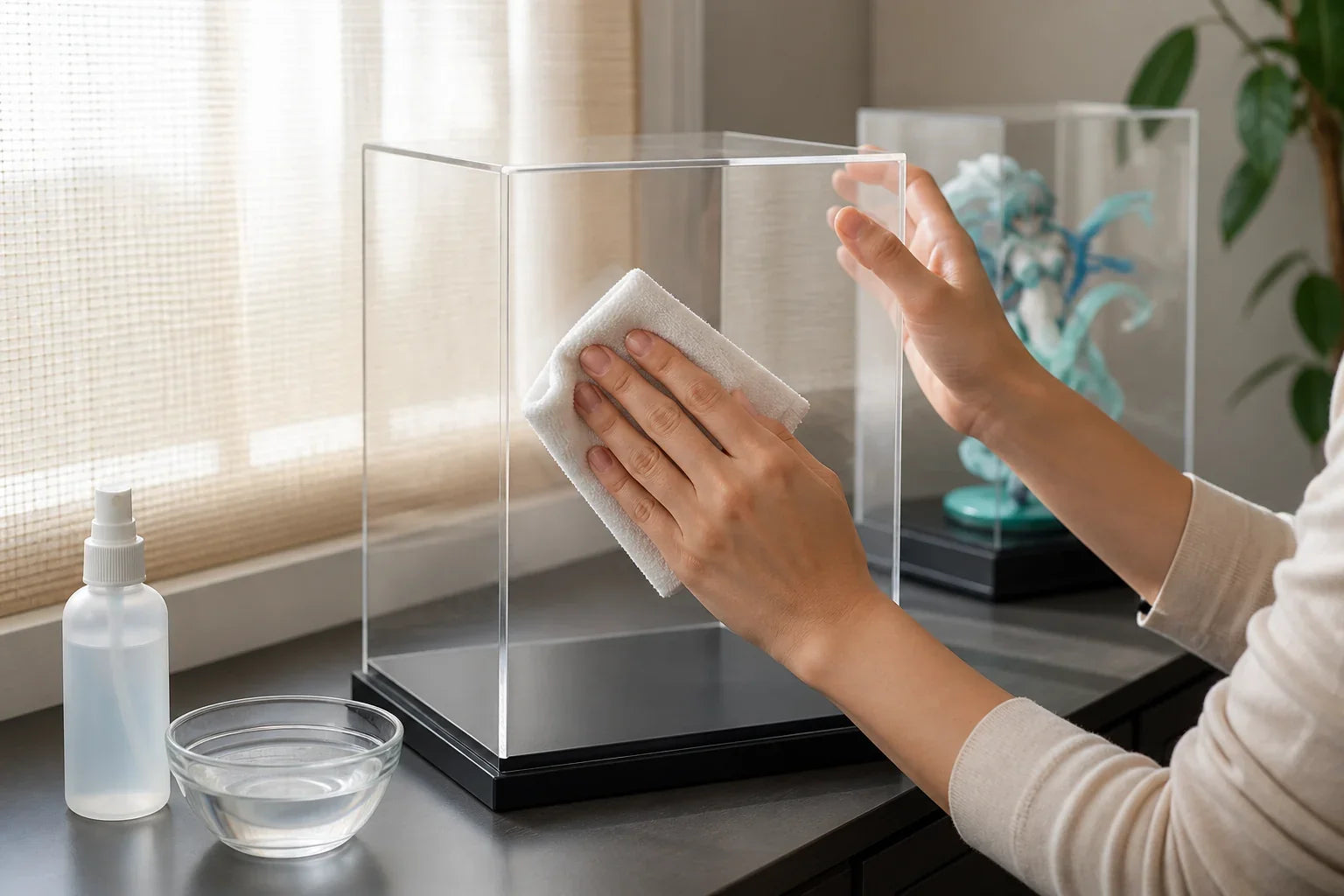
Acrylic should not be cleaned like a window. Its smooth surface is easy to maintain, but dry dusting, paper towels, abrasive pads and unsuitable household sprays can create fine scratches, static or cloudy patches.
The safest routine is simple: remove the cover, loosen dust with water, use a clean soft lint-free cloth and choose only a cleaner intended for acrylic or thermoplastics. The method matters more than force.
Quick acrylic cleaning checklist
- Remove the object before cleaning whenever practical
- Lift the acrylic cover with two hands and place it on a clean soft surface
- Use lukewarm water and a soft lint-free microfibre cloth
- Add a small amount of mild washing-up liquid for ordinary marks
- Use a dedicated antistatic plastics cleaner for the best dust control
- Apply cleaner to the cloth rather than spraying near the exhibit
- Use light pressure and never scour
- Do not rub the acrylic bone-dry
What you need
- Two clean, soft, lint-free microfibre cloths reserved for acrylic
- Lukewarm clean water
- A drop of mild washing-up liquid without abrasive particles
- An acrylic-compatible antistatic cleaner for periodic care
- A clean towel or soft mat on which to rest the cover
Wash cloths separately from gritty household cleaning fabrics. A good cloth with one trapped hard particle can drag a scratch across an otherwise perfect panel.
Step-by-step: how to clean an acrylic display case
1. Prepare a clean working area
Clear enough space to place the cover down safely. Remove watches, rings or bracelets that could contact the acrylic. Put a clean soft towel or non-abrasive mat on the table.
2. Remove the cover and object
Lift the cover vertically with two hands, supporting opposite lower edges. Do not twist it, pull one corner or use the top as a handle. Move the object to a safe place before using water or cleaner.
If the cover is too large or heavy for one person, ask for help. Preventing a dropped case is more important than completing the cleaning immediately.
3. Remove loose dust with moisture
Lightly dampen a clean cloth with lukewarm water and place it against the surface before wiping. Moisture captures dust so particles are lifted rather than dragged. Do not begin with a dry duster.
Work from the top down. Fold the cloth to expose a clean face as it picks up dirt.
4. Wash fingerprints and ordinary marks
Add a very small amount of mild washing-up liquid to the water. Wipe gently in overlapping straight passes with light pressure. Support the panel from the opposite side instead of pushing the cover across the table.
Use a second damp cloth with clean water to remove any detergent residue.
5. Apply an antistatic acrylic cleaner when needed
Acrylic can become electrostatically charged and attract airborne dust, especially after dry rubbing. An antistatic cleaner made for acrylic or thermoplastics helps reduce this attraction.
Follow the product instructions. As a safe general practice, apply a small amount to the cloth rather than spraying towards the exhibit, base, electrical lighting or surrounding furniture. The acrylic cleaner and cloth pack is designed for this type of care.
6. Allow a clean finish without aggressive drying
Use a clean, slightly damp cloth for the final pass and let the remaining moisture evaporate. Vigorous dry buffing creates static and increases the chance of fine scratches. Check the surface in soft side light rather than pressing harder at every reflection.
Safe choices and products to avoid
| Generally suitable | Avoid unless the acrylic manufacturer explicitly approves it |
|---|---|
| Lukewarm water | Very hot water or steam cleaners |
| Mild washing-up liquid | Scouring cream or powder |
| Soft lint-free microfibre | Paper towels, kitchen roll or abrasive pads |
| Dedicated acrylic/plastics cleaner | Ordinary glass or window cleaner |
| Acrylic polish used according to instructions | Acetone, thinners, solvent cleaner or nail-varnish remover |
| Light pressure on a supported panel | Razor blades, scrapers or melamine “magic” erasers |
Some specialist acrylic manufacturers approve particular grades and concentrations of isopropanol for specific products, while warning against other alcohols and additives. Because household sprays vary, do not assume “alcohol-based” means safe. Use the cleaner recommended for the actual acrylic and test any unfamiliar product on a discreet area.
How to reduce dust and static
A case keeps most household dust off the object, but its outer surface still needs attention. To slow dust build-up:
- Use an antistatic plastics cleaner periodically
- Avoid dry feather dusters and synthetic cloths that generate charge
- Keep the case away from open windows, busy vents and cooking aerosols
- Clean the shelf and surrounding area before replacing the case
- Handle the cover by its lower edges with clean hands
Do not place an air purifier or fan so that its outlet blows directly across the display. Moving air can carry more dust to the surface even when the room itself is cleaner.
Preventing scratches during normal use
- Never place keys, frames, cleaning bottles or another case on top.
- Do not slide the cover across a gritty base; lift it vertically.
- Keep the object clear of every wall so it cannot rub against the acrylic.
- Support large covers with two people.
- Store a removed cover upright only when it is safely supported; otherwise place it on a clean soft surface.
- Keep transport film or a soft protective sleeve for future house moves where practical.
If a mark appears, first clean the surface fully. What looks like a scratch may be a streak or transferred material.
Can scratches be polished out?
Very fine surface marks and haze can sometimes be improved with a dedicated acrylic polish. Use a clean soft cloth, minimal pressure and the product manufacturer's method. Work on a small area and inspect it before continuing.
Deep scratches, cracks, crazing near a joint or widespread chemical clouding need professional assessment. Aggressive sanding by an inexperienced owner can create optical distortion and make the damaged area larger. Do not polish a signed, painted or coated surface unless you know the coating is compatible.
UV resistance does not necessarily protect the object
Clear acrylic is often described as UV-resistant. Usually, that refers to the material's ability to resist yellowing and weather degradation. It does not automatically mean the sheet is a verified UV filter for photographs, signatures, textiles, pigments or other sensitive exhibits.
Specialist UV-absorbing acrylic grades exist for display and conservation work. If UV performance matters, ask for the grade and its transmission data rather than relying on a general “acrylic” description.
How to reduce fading and light damage
Light damage is cumulative. A case reduces dust and handling, but it does not make direct sunlight safe. Protect sensitive objects by:
- Keeping the case out of direct sun at every time of day and season
- Using blinds or curtains where daylight reaches the display
- Choosing low-UV, low-heat LED lighting
- Positioning lamps outside the case rather than trapping heat inside
- Turning lights off when the display is not being viewed
- Rotating especially sensitive items or displaying replicas where appropriate
- Requesting a conservation specification for irreplaceable material
Paper, photographs, signatures, textiles, leather, dyed plastics and painted surfaces can all respond differently to light. Museums and owners of valuable collections should seek object-specific conservation advice.
Heat, moisture and placement
Avoid radiators, fireplaces, conservatory windows and powerful lamps. Heat can affect the object, acrylic, adhesives and base, while a closed case can become warmer than the surrounding room.
Do not enclose an item that is wet, freshly painted, recently solvent-cleaned or giving off a strong chemical smell. Let materials cure and dry fully. For museum, archive or high-value use, check the compatibility of base coverings, adhesives, paints and sealants rather than assuming every decorative material is conservation-safe.
Frequently asked questions
Can I use window cleaner on an acrylic case?
No. Many window cleaners contain ammonia, alcohols, fragrances or solvents that may haze or stress acrylic. Use lukewarm water, mild detergent and a cleaner specifically labelled for acrylic or thermoplastics.
Can I use kitchen roll?
It is best avoided. Paper fibres can be surprisingly abrasive and may drag dust across the surface. Use a clean, soft, lint-free microfibre cloth reserved for the case.
Why does the case attract dust after cleaning?
Dry rubbing can create static charge. Clean damp, avoid aggressive dry buffing and finish with an acrylic-compatible antistatic product.
Does an acrylic case stop fading?
Not by itself. A standard clear case should not be assumed to provide conservation-grade UV filtration. Keep the display out of direct sunlight and specify specialist UV-filtering material where required.
How often should I clean the case?
Clean only when needed. Frequent unnecessary wiping creates more opportunities for abrasion. Remove visible dust gently and deal with fingerprints promptly rather than following a rigid weekly schedule.
Correct care keeps the object visible and the cover unobtrusive. If you are planning a new display, browse acrylic display cases or configure a custom-size acrylic case with enough clearance for safe cleaning and cover removal.