
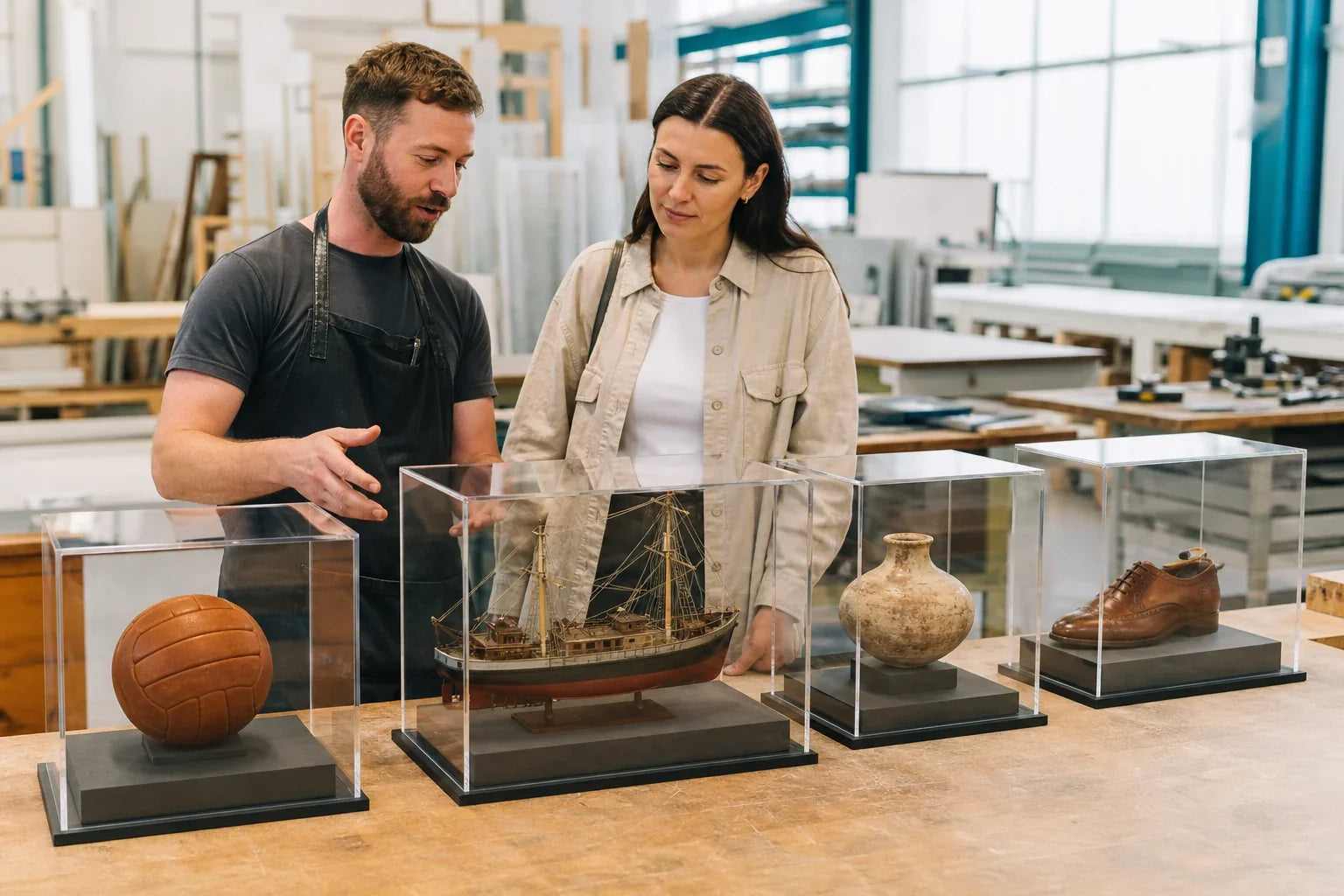
A custom display case project succeeds when the brief describes the object, the audience and the environment—not just three dimensions. A collector removing a cover twice a year has different priorities from a museum displaying light-sensitive material or a retailer cleaning a unit every morning.
The four scenarios below show how to plan bespoke acrylic display cases for sports clubs, private collections, museums and retail. They are practical briefing examples, not claims about named client commissions. Use the checklists to turn an idea into information a fabricator can quote and manufacture.
Start with the question the display must answer
Before choosing material or colour, write one sentence describing the purpose:
- “Protect and present a signed match ball in our reception.”
- “Keep dust off a model ship while preserving a clear side view.”
- “Display a robust replica in a temporary exhibition with daily public traffic.”
- “Create 30 repeatable counter displays for a product launch.”
This sentence exposes the real design drivers: protection, view, access, branding, quantity, environment and deadline.
Scenario 1: a sports club memorabilia display
A club display may contain a signed football, match-worn boot, medal, programme, photograph or plaque. The emotional value is often greater than the material value, and the case will probably sit in a reception, hospitality suite, trophy room or supporter area.
What to decide
- Hero object: identify what should catch the eye first.
- Orientation: rotate the signature, date or important panel towards the viewer.
- Mount: choose a ring, riser, boot support or discreet bracket that keeps the object stable.
- Supporting material: decide whether photographs and text sit inside the case or on an external label.
- Audience distance: a reception display is usually viewed from further away than a home shelf.
- Security: a lift-off cover may suit a supervised room; a busy public space may need a fixed or lockable installation.
- Light: signed surfaces and textiles should be kept out of direct sunlight.
A useful club brief
“One signed size-5 football on a 40mm-high ring, with a separate 120 × 40mm plaque in front. The signature must face the front-right corner. The case will stand on a 600mm-deep reception cabinet, be viewed mainly from the front and cleaned monthly. Please quote a black base and a removable clear cover.”
Browse football display cases, boot display cases and other sports options before commissioning a completely new format. A standard product with an appropriate mount may be quicker and more economical.
If artwork, a crest or sponsor mark will be reproduced, confirm that the club or customer has permission to use it. A fabricator cannot assume trademark or image rights from receiving a file.
Scenario 2: a private collector's model case
Collectors commonly need cases for model cars, aircraft, ships, brick-built models, figures, trains and mixed memorabilia. The challenge is usually not the main body; it is the small projection, stand angle or future addition that changes the occupied envelope.
What to decide
- Build and pose the model completely before measuring.
- Include aerials, wings, masts, propellers, figures and cables.
- Choose the view: straight-on, three-quarter, side profile or all-round.
- Allow enough internal clearance to lower the cover without catching fragile parts.
- Decide whether the model stays on its own base or transfers to the display-case base.
- Check that the completed case fits the furniture and can reach the room.
- Plan lighting outside the case where possible to avoid heat and trailing cables.
A useful collector brief
“A completed model on its stand occupies 720mm wide × 310mm deep × 420mm high. The wing tips are fragile, so we want at least 40mm internal clearance on both sides, front, rear and above. It will be viewed from three sides on a 500mm-deep cabinet. The clear cover should be removable by two people, with a matte black base and no mirror.”
Use the detailed display-case measuring guide and clearance guide before requesting a price. Brick-built models can also use the custom model case calculator.
Scenario 3: a museum, archive or heritage display
Institutional projects need a performance brief, not simply a transparent box. The object may have defined limits for light, UV, humidity, pollutants, vibration, support materials, security and access. Those requirements should come from a conservator or collections professional before the case is specified.
Questions for the institution
- Is the object original, a replica or replaceable interpretation material?
- Is it sensitive to light, UV, humidity, pollutants or temperature?
- Does it require a sealed microclimate, passive buffering or active monitoring?
- Which materials may safely sit inside the enclosure?
- How often will staff need access, and what is the safe handling procedure?
- Does the case need locks, tamper resistance or a fixed installation?
- Are there loan-condition, fire, accessibility or institutional standards to meet?
- Who approves the shop drawing and material samples?
A standard acrylic cover reduces dust and handling, but it should not be described as an airtight conservation microclimate. Standard clear acrylic's resistance to weathering also does not prove that it provides a specified level of UV filtration for the object. Specialist grades, seals, base materials and lighting may be required.
A useful heritage brief
“The object is a robust replica used for a six-month temporary display. It is not humidity-sensitive. The case must prevent casual touching, use materials approved by our conservation team, provide staff access from the rear and withstand daily public traffic. Please supply material data and a drawing for approval before manufacture.”
For an original, fragile or high-value object, involve a conservator. Send the agreed performance requirements through the Puffin Plastics contact page so the team can confirm whether the project is within scope.
Scenario 4: a repeat retail display
Retail display cases must make a product easy to see while surviving frequent cleaning, staff changes and repeated roll-outs. A beautiful one-off is not enough if the 30th unit differs from the first or takes too long to assemble.
What to decide
- Quantity: prototype, initial batch and likely repeat volumes.
- Product envelope: the largest item or variant the unit must accept.
- Access: lift-off cover, hinged door, open rear or secured access.
- Cleaning: daily method, approved product and replaceable parts.
- Branding: artwork ownership, colours, print method and changeable campaign graphics.
- Installation: who assembles it, how long it takes and which tools are allowed.
- Packing: individual cartons, pallet quantities, store labels and damage replacements.
- Repeatability: revision control for drawings, samples and signed-off tolerances.
A useful retail brief
“We need one prototype followed by 30 counter displays. Each must hold products up to 280 × 180 × 160mm, be wiped daily, fit a 450 × 350mm counter zone and allow staff access without tools. Campaign graphics must be replaceable. Please separate prototype, production, packing and delivery costs.”
For repeat work, provide target quantity and delivery locations at the first enquiry. Material yield, jigs, packaging and freight can affect the right design.
The information every custom case enquiry should include
Copy this checklist into an email and complete what you know:
- Project name:
- Purpose and audience:
- Object description and value/sensitivity:
- Occupied width × depth × height in millimetres:
- Required internal clearance:
- Stand, mount, plaque or base details:
- Preferred external maximum size:
- Viewing directions:
- Access frequency and method:
- Material, UV, security or conservation requirements:
- Base colour and finish:
- Mirror backing, engraving, print or vinyl requirements:
- Quantity now and likely repeat quantity:
- Required delivery date and postcode:
- Installation or access restrictions:
- Photographs and dimensioned drawing attached:
- Artwork rights confirmed where applicable:
Photographs and drawings that prevent mistakes
Send clear front, side and three-quarter photographs. Include a rigid rule in at least one image for scale, but do not ask the fabricator to calculate final dimensions from a photograph alone.
A simple dimensioned sketch is extremely useful. Label:
- Width, depth and height
- Which measurements are internal and external
- The front of the display
- Object position and clearance
- Holes, notches, cable routes and access panels
- Base, mirror and mount thicknesses
For complex or repeat projects, request a drawing approval stage. One named approver should sign off the revision used for manufacture.
What drives the cost of a bespoke display case?
- Overall dimensions and material thickness
- Clear, coloured, mirrored or specialist sheet
- Edge preparation, bonding and polishing method
- Base material, colour, recess and mount
- Cut-outs, bends, doors, hardware or unusual shapes
- Engraving, print, vinyl or replaceable graphics
- Prototype and drawing requirements
- Quantity and repeatability
- Protective packing, parcel or pallet delivery
- Installation and site access
Simplifying dimensions, using a standard product or reducing unnecessary features can save more than choosing a sheet that is too thin. Never reduce material below the structural minimum for the finished size.
Lead time and approval
Puffin's standard bespoke cases are typically produced in approximately 14 working days before dispatch. Complex institutional work, prototypes, specialist material, large quantities or client approval stages may require a different schedule.
Work backwards from the real installation date and include time for:
- Brief clarification
- Material availability
- Drawing or prototype approval
- Manufacture
- Quality checking and packing
- Delivery, installation and contingency
Do not book a launch around an assumed production date before the specification and delivery method are agreed.
Turning a completed project into a genuine case study
A real customer story can help future buyers if it is documented honestly. With written permission, collect:
- The customer's original problem
- Verified object and finished case dimensions
- The reason for material, base and access choices
- Workshop and installed photographs
- A genuine customer quotation
- Permission to name the organisation and reproduce logos or artwork
- Any limitation or lesson that would help the next buyer
A specific, evidence-based case study is more useful than a generic gallery. It also gives clubs, museums and retailers a credible page they may choose to reference from their own websites.
Frequently asked questions
Can Puffin make one custom case?
Yes. The online calculator is designed for one-off made-to-measure acrylic covers as well as repeat orders within its size range.
Can the same design be repeated for several locations?
Yes, but the prototype, revision, packaging and delivery plan should be agreed before the main run. State current and likely future quantities in the enquiry.
Can you reproduce a club crest or company logo?
That depends on the technique and project, and the customer must hold permission to reproduce protected artwork. Supply suitable files and written confirmation of the rights where requested.
Can a standard acrylic case protect museum objects?
It reduces dust and handling but should not be assumed to provide a sealed conservation environment, verified UV filtering or institutional security. Define those requirements with a conservator before asking for a quotation.
What if the object is larger than the calculator allows?
Send the full brief, drawings and delivery location for individual review. Any external dimension over 900mm requires a quotation.
For a straightforward one-off, configure a custom acrylic display case online. For clubs, institutions, retail batches, unusual shapes or large projects, send the completed brief through the Puffin Plastics contact page.